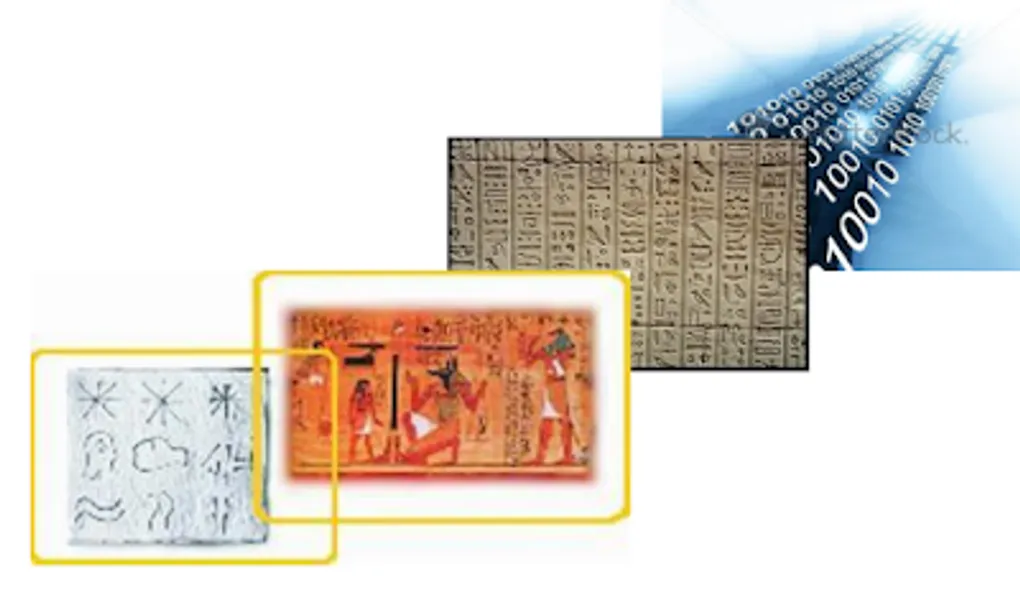
A Brief History of Information Technology
1. Pre-Historic Era (… to 3000 BC)
- In pre-historic times, information technology was used as a system to identify recognizable shapes. Information was conveyed through drawings on cave walls or stone cliffs.
- Communicating via images/paintings was the preferred choice because spoken language at the time was limited to grunts and hand signals.
- Later developments saw the use of sound-producing tools and signals, such as drums and trumpets made from animal horns, as well as smoke signals to warn of dangers.
 |
|---|
| The Era of Mammoths |
 |
|---|
| Communication via Smoke |
 |
|---|
| Horn Trumpet |
2. The Historical Era (3000 BC to the 1400s AD)
During this period, information technology evolved among the upper classes, such as tribal leaders, and was used for specific activities like ceremonies and rituals. It was not yet mass-produced as it is today.
a. 3000 BC
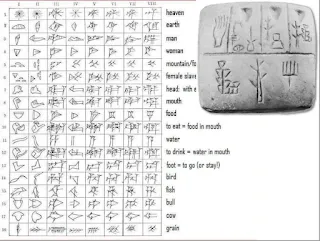
- People began to recognize symbols and writing. The Sumerians were the first to use symbols to convey information.
- Their writing consisted of pictographs as letters. These symbols already had distinct sounds when spoken, allowing for the formation of words, sentences, and languages.
 |
|---|
| Ancient Sumerian Language |
b. 2900 BC
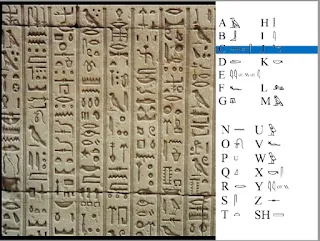
- The Ancient Egyptians developed and used Hieroglyphics.
- Hieroglyphics used symbols for expressions. Each expression had a unique symbol, and when combined, they had specific pronunciations and meanings. This system was more advanced than that of the Sumerians.
 |
|---|
| Hieroglyphic Symbols |
c. 500 BC
- This era marked the shift from clay tablets to more flexible media.
- Humans began using fibers from the Papyrus plant, which grew along the Nile River. Papyrus was stronger and more portable than clay tablets.
- Papyrus fibers were the precursor to the paper we use today.


d. 1455 AD
- Marked by the development of the Printing Press. Initially, metal plates were used.
- Johann Gutenberg later developed wooden frames for printing, revolutionizing mass communication.

The 1800s
- 1830: The birth of computer programming. Augusta Ada Byron wrote the first computer program alongside Charles Babbage. They used the Analytical Engine, designed to receive, process, and output data via punch cards. This was the mechanical precursor to modern digital computers.
- 1837: Samuel Morse, along with Sir William Cooke and Sir Charles Wheatstone, developed the Telegraph and Morse Code. This allowed electronic information transfer over long distances for the first time.
- 1861: People began exploring moving images on screens, the precursor to modern cinema.
- 1876: Melvil Dewey developed the Dewey Decimal System for library classification.
- 1877: Alexander Graham Bell popularized the Telephone.
- 1877: High-speed photography was invented by Eadweard Muybridge.
- 1899: The first magnetic tape storage systems were used.
The 1900s
- 1923: Zvorykin manufactured the first Television (TV) tube.
- 1940: World War II accelerated IT development for military document transfer and storage using magnetic tape.
- 1945: Vannevar Bush proposed a hypertext-based coding system.
- 1946: The world’s first digital computer, ENIAC I, was completed.
- 1948: Scientists at Bell Labs developed the Transistor.
- 1957: Jean Hoerni developed the planar transistor, enabling billions of transistors to fit on a single silicon chip.
- 1957: The USSR launched Sputnik, the first artificial satellite. In response, the US formed ARPA to advance military IT.
- 1962: Paul Baran was tasked with creating a decentralized network system capable of surviving a nuclear war.
- 1969: The first network system (ARPANET) was formed, connecting four nodes at US universities.
- 1972: Ray Tomlinson created the first e-mail program.
- 1973–1990: The term “Internet” was introduced in a paper on TCP/IP, developed by a DARPA-led group.
- 1986: The IETF developed a server system to coordinate DARPA, ARPANET, DDN, and the Internet Gateway.
- 1991: Commercial IT began as CERN sought to recover costs by charging members for services.
- 1992: The Internet community formed, and CERN introduced the WWW (World Wide Web).
- 1994: The internet began to grow exponentially, becoming an inseparable part of human life.
- 1995: Commercial companies were allowed to become internet providers by purchasing backbone capacity, sparking rapid innovation.